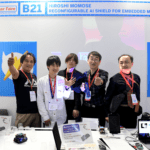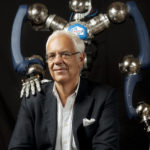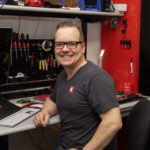
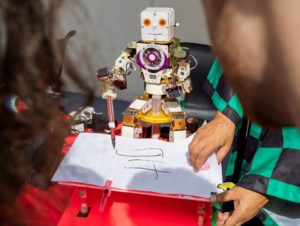
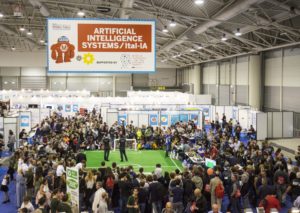

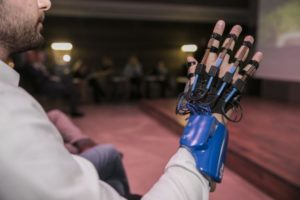





Milan, Florence and Simbario: three different cities joined together by an imaginary line that leads to innovation. In each of them, stories of fabbers and makers intertwine, told by “the Italian savoire-faire”. It is a short film published on Vimeo, entirely produced, written, directed, edited and post-produced by filmmaker Ena Granulo (@EnaKG). The original soundtrack is composed by Barnabas Folk.
The characters
#Makertour comes back to Italy!
<iframe src=”http://www.youtube.com/embed/wUkGwK2XVSQ” height=”315″ width=”560″ allowfullscreen=”" frameborder=”0″></iframe>
Massimo Menichinelli: how to export a FabLab from Finland
When he answers the Skype call, Massimo Menichinelli has just finished testing the new cutter arrived to his laboratory. He was born in La Spezia in 1980 and is now the producer of Aalto Fablab. He travelled to Finland for the first time in 2009, when he was invited as a keynote speaker in Helsinki as an expert in the field of design (you can find everything on the blog openp2pdesign) and collaborative projects. When the university asks him for his view on the most interesting experimental projects, Massimo recommended a FabLab.
A year later, he applies for a PhD at the Aalto University and discovers that the university is actually setting up a FabLab. The opportunity was too good to miss so he got involved in the project. How long did it take?
“Officially, the FabLab was launched on 15 June 2012. Neil Gershenfeld was at the inauguration in video conferencing as well as many other personalities like Alex Schaub. Works began a year and a half before; now the lab is part of the Media Factory. It is one of four hubs that operate as a bridge between departments and research centres, but it also acts as a membrane reaching out to citizens and outside companies. Its role is to facilitate interaction with photography-related, video making, cinema and data visualisation projects. The FabLab is part of it because it is a bridge between digital technology and the real world. In short, from bits to atoms and vice versa.”
How to hack bananas with MaKey MaKey
Explaining young people that objects conduct electrons can be frustrating and, at times, terribly boring. But if you tell an entire classroom to transform a basket of fruit into a computer keyboard, then things change. Curiosity is unleashed and a lesson on electrical conductivity becomes more enjoyable.
This is, more or less, what happens when you put your hands on Makey Makey. It may look like an old Super Nintendo controller, but it is actually an electronic card capable of transforming electrical impulses in computer input. This means that whatever is connected to Makey Makey becomes an 18-key keyboard. It can be anything, as long as it is not made of insulating material.
A Makey Makey is very easy to use. Just connect it to your computer through a USB cable and connect the terminals to the chosen electrical power source. To be honest, there is plenty of choice because the list includes everything from ketchup, graphite (pencil lead), lemons, plants, coins, grandma and her silverware, moist stuff, various types of food, dogs, cats, aluminium foil and even rain.
Once ready, the plug and play interface allows you to let go of your creativity. Just let the electrons run and see what happens. A staircase can become a piano, four buckets full of water change into an interactive platform and a few pieces of modelling clay can get you to play Super Mario. Makey Makey is made to play, but behind it there is a lot of electronics, including firmware by Arduino Leonardo. All hardware is open source and, if necessary, the entire software can be reprogrammed by whoever knows a bit of code.
Behind Makey Makey (the name comes from the combination of Make and Key), there’s Eric Rosenbaum and Jay Silver, two PhD students at MIT. To make it they asked for support through a crowd funding campaign on Kickstarter in June 2012. The two inventors needed 25,000 dollars. In a month, they put together 568,000… The idea worked, definitely. If you want one, put your hand up. Here you’ll find everything you need to know. Have fun!
GPS shoes for finding the way home
Shoemakers have always made excellent footwear, but have never been able to make a pair that takes you all the way home. In the sense that they show you, step by step, the right road to take to get to your own roof. All in one pair of shoes. If you think this is impossible, it means that you have never seen what British designer Dominic Wilcox has done with his No Place Like Home.
Let’s take a step backward. Do you remember “The Wizard of Oz”, the 1939 film in which the protagonist Dorothy taps the heels of her ruby shoes together three times to magically go home again? Wilcox was inspired by those very shoes, and created a pair in leather (this time for men) equipped with an integrated GPS.
How to build a toy castle with a laser
Bringing home a castle, stone by stone, is not easy. But, if you really do not want to do without your own personal fortress, you could make it using a laser cutter. It takes 32 sheets of 6 mm poplar plywood and the imagination of Andrea Garuti, an engineer from Modena. At the contest Make Your Laser Cut Toy he crushed the competition with a modular set that rivals those of even the best toy stores.
His castle in wood is supposed to be designed for children, but it is not hard to imagine that adults too will be hopelessly bewitched by it. In addition to the fortress with a drawbridge, you will find rams, catapults, trebuchets and a small village. As the Vectorealism blog recounts, the only thing the model is lacking are the miniatures (which, for example, you might decide to print in 3D). However, the beauty of it is that anyone can have it at home.
(more…)
Eddie Kirkby: let’s build 30 FabLabs to change the UK
There is a place where you can make (almost) anything. Actually, there are many places like this. One of such places is FabLab Manchester, launched in March 2010, based on the digital fabrication laboratories model (hence FabLab) conceived by Neil Gershenfeld at the MIT.
To date, approximately 7,000 users have used the Manchester labs, giving life to great and small ideas. We have Eddie Kirkby, Charity & Operations support manager at the Manufacturing Institute, Manchester and guest at the Atoms, Bits & People meeting in Rome on May 24 to tell us more about FabLabs.
Eddie has coordinated the FabLab Manchester project since 2009, when the Manufacturing Institute decided to bring Gershenfeld’s model to the UK and contaminate it with the culture of the makers. But is it true that it is not just about bits and atoms?

“It’s not the machinery that makes the FabLabs unique, but rather, the people and network. With a little help anyone can learn to use the tools and create something. This is why free access to the facility is essential and makes the FabLabs different from university or private laboratories. As well as the fundamental idea that the brightest people don’t always work in large institutions.”
The individuals and the idea that everyone can be a maker, even without knowing it, are at the centre of everything. How can you stay true to such an ambitious mission?
“Our first goal is to involve an ever expanding community on the topic of digital manufacturing. It’s simple: people should be able to make their own things and have fun while doing it. The Manchester FabLab was the first one opened in the UK and, from the outset, it has distinguished itself for its focus on economic sustainability. To survive a FabLab must cover its costs and balance its educational mission ensuring open access to the public. In our case, Fridays and Saturdays are always open days: anyone can come to us to learn and make something. Furthermore, we offer a brief introduction on machinery and safety regulations.”
Why the 3D printing of guns has been blocked
3D printers can create anything. But there is a limit to this freedom. And it is a limit that can make a difference, especially when it comes to weapons. It’s all going on in the United States, where the Second Amendment of the Constitution guarantees citizens the right to bear arms. But what if the designs for a plastic gun go around the world via the Internet and end up in the wrong hands?
The issue is becoming complicated. The weapon in question is called the Liberator, and Forbes magazine has gone to find its inventors in Austin, Texas. They are a group of young people who gave birth to Defense Distributed, an association that supports the “Wiki Weapon Project” and the unlimited 3D printing of firearms.
The Liberator is a gun made up of 16 plastic parts that can fire one 7.62 mm bullet at a time. After each use, the weapon must be manually reloaded, and its does not yet operate flawlessly. Indeed, when more powerful bullets are fired, the weapon can still jam or explode.
As is the case for other makers, the creators of the Liberator held a crowdfunding campaign on the Indiegogo platform in order to finance the Wiki Weapon. However, the collection of funds was cancelled in August 2012 by the service providers, who were opposed to the idea of supporting firearms. Despite the setback, field trials have been continuing, as the 25-year-old founder, Cody Wilson, explained to Wired.
“We used 60 to 70 different springs, not all separate designs, but just trial and error. We cannibalized a spring off a toy on Thingiverse, a wind-up car toy.”
And so, on 5 May 2013, the Liberator CAD was released online to be downloaded freely. After a few days – and about 100,000 downloads, according to the developers – the file was blocked and removed by operators following the intervention of the Department of State.
According to the Commodity Jurisdiction the Liberator is currently an unregistered weapon; i.e. before it can be disseminated, it must pass through a Department of State assessment procedure. One “trigger” for the ban was, in particular, the fact that the gun can be made by anyone with a 3D printer.
In this case, the makers’ liberties may be harmful. Distributed Defense has a valid licence to produce weapons in the U.S. without exporting them, such that the original Liberator model includes a metal insert and a serial number which makes the gun traceable. But the CAD broadcast by the Texans may be amended by deleting the identifier and replacing the metal with normal plastic. And it can go around the world with a single click.
But the story does not end here. The Defense Distributed blog shows the letter in which the Department of State suspended the distribution of Liberator files and other accessories of violence. This is not a complete ban, but a temporary block during which Wilson and his team will have to prove that the 3D-printed gun complies with U.S. law.
Europe, however, has more restrictive laws: simply take a look at the GunPolicy portal for evidence of this. If someone were to print a Liberator in a European country, they would probably not get away with filling out a simple form.
Things to do in May, if you are a maker
There are some packed weeks ahead for followers of the DIY movement and for makers and fabbers. In addition to the event with Neil Gershenfeld in Rome on 24 May, there are numerous opportunities to come into direct contact with the new industrial revolution. Below, you’ll find details of all the European events not to be missed this month, including workshops, events and festivals.
The Future of Food printed in 3D
As much as you may love traditional dishes, you should know that 3D printers are about to enter your kitchen. If you are looking for a way to reduce food waste, you could turn to the culinary machines from Cornell University. The American university has devoted years of research to technologies for printing lunch and dinner by mixing the ingredients in the right doses.
The food printer prototype is very similar to traditional 3D printers, but instead of plastic the movable nozzles extrude pre-mixed ingredients. Since the kitchen machine is controlled by a computer, you can customize every last calorie of the food product. The reason that this is considered useful is explained by Jeffrey Lipton, a mechanical engineer at CornellUniversity.
Is copying popular designs so wrong?
Imagine that you are visiting the website of an online shop and you come across an item that you love at first sight. The temptation to buy it is very strong, but the 3D printer behind you tells you a something else… Put your credit card away and go to Thingiverse or Instructables to see if someone has already released a project that you can copy or re-invent yourself with your own hands.
The makers’ new industrial revolution resembles to some extent the wave of music downloads that stunned the music industry some time ago. All that was only available from the shops until a moment ago suddenly becomes downloadable from the Internet. Of course, the process for making actual objects is a bit more complicated, but not impossible.
Real problems come up when copying famous designs. The designers might not like that copyright and intellectual property (if applicable) are so easily bypassed. This is a legitimate concern, a challenge taken on by Diederik Schneemann. The designer from Rotterdam presented his “Mash-Up” video at the Fuorisalone in Milan, raising a fundamental question: will 3D printing be the worst nightmare of copyright?
“I’m convinced there will be no way of stopping this 3D printing trend.More and more, designs will emerge on the Internet, making it hard, maybe even impossible to control the copyrights on every newly created or copied item posted on the Internet. Are we moving towards the next Napster of Design?”
#MakerTour @ Codemotion Berlin
Five DIY ideas for role play and cosplay
Dismissing them as nerds is unforgivable flippancy. It often seems that role-players and cosplayers live in a galaxy far, far away, but in reality there are creatives and fabbers among them able to create phenomenal costumes from makeshift materials. For example, have you ever thought about how to use a plastic bowl for the costume of Bane?
In these cases, to be successful you literally need to put creativity on. Nevertheless, do-it-yourself has many advantages: it stimulates the brain, you can learn from mistakes and it respects your wallet. If you’re eager to get to work, take a look at Instructables. There you’ll find really genial ideas and solutions. Here we report five of them.
Meet the maker: Massimo Banzi at Codemotion Berlin
Meet the maker: Dale Dougherty
The first time that I heard the word maker it was in front of a TED video. The speaker was Dale Dougherty, creator of the magazine Make, one of the most committed and charismatic spokesmen of the movement. I was struck by his enthusiasm when explaining the revolution of makers, their cohesive and open source movement.
I found him again on the stage of Ouishare with his slides: a machine covered in talking fish, a 3D printer that created a glass, a robot capable of using tools to make a scarf, the latest genial invention at the Makefaire in New Castle.
How to enjoy the Internet of Things with Twine
Objects can speak to people and their language is by no means illogical. Indeed, for some years now, the Internet of Things (IoT) has been gradually invading our live. If you are curious enough to want to become personally involved in the challenge of interconnecting intelligent objects, you can take the first easy step with Twine.
At first sight, Twine looks like a simple blue box, but in reality this conceals three sensors (temperature, vibration and orientation) capable of interacting with the surrounding environment. You just have to switch it on, connect it to your Wi-Fi system and programme it by means of a simple interface.
Why the makers were popular in Florence
The woman in this photo works with textiles. There is nothing odd about what she is doing, but she is surrounded by 3D printers, laser cutters and Arduino boards. This implies that there is, after all, a form of continuity between past, present and future knowledge. Over the course of nine days, Popup Fablab brought the creative talents of makers and “fabbers” to the International Craft Fair in Florence, and the result was a minor success.
The technology transforming tomorrow’s clothes
It seems like an advertising slogan, but inside all the clothes of the future there really will be a bit of technology. We’re not just talking about avant-garde manufacturing techniques, but about real applications which will change textile fibres into genuine circuits. So the day will come when your jackets will tell you its temperature and communicate with your smartphone.
These features often depend on sensors and microcontrollers sewn into turn-ups. In other cases, cotton or nylon fabrics are exchanged with conductive textiles which allow the garments to contact a computer (as in the case of Plug and Wear). In practice, the only limit is the extent of our ambition to experiment with new forms of intelligent interaction.
How to build a farm with Open Source Ecology
The makers are not just about electronics, we know that. There are those who build robots and then there are those dedicated to tractors. There is nothing strange in this: work on the farm can have very respectful technological roots. The most pertinent demonstration comes from Open Source Ecology (OSE), the project created by Marcin Jakubowski, a physicist born in Poland who moved to the United States as a child.
Jakubowski left research behind to move to the country and take care of his farm, but with an eye for open source and the sharing of ideas. The point is this: if you need a tractor, that doesn’t necessarily mean you have to buy it. You can build it with your own hands. Easy to say, but far from impossible. To do this you just need some spot-on advice.
The makers and Massimo Banzi ready for Codemotion
The days are visibly getting longer and attention is turning to Berlin. The German capital will host Codemotion, three days dedicated to workshops, talks and meetings devoted to software and hardware programming in all its forms. Guests not to miss are Massimo Banzi, Zoe Romano and Kentstrapper. The appointments of the week follow.
Geneva is home to the Mapping Festival until May 12. This is a good opportunity for immersion in various installations dedicated to the audio-visual arts and digital culture. There is no lack of conferences, meetings and performances to navigate the universe of creativity. Tickets can be found on the event website.
Where: Geneva, Switzerland
When: May 6, 7, 8, 9, 10, 11, 12
Codemotion Berlin opens on May 9 and devotes the next two days to various topics of discussion. On May 10, do not miss the presentation by Massimo Banzi “People over MHz” and remember that on May 11 there is a whole programme of meetings dedicated to makers, fabbers and 3D printing. You can find all the tickets on Eventbrite.
Where: Berlin, Germany
When: May 9, 10, 11
The makers disembark at ISIA in Faenza to talk about themselves in Make Your Future. It is a meeting that focuses on stories, experiences and projects from the world of DIY to explain what is happening inside the new industrial revolution. Guests include Alessandro Ranellucci Alexander (Slic3r developer), Fernando Arias (Fab lab Reggio Emilia), Andrea Radaelli (Sharebot), Enrico Bassi (Fab lab Turin), Ugo Cantini (Kentstrapper), Massimo Moretti (WASProject) and Andrea Cattabriga (Slowd).
Where: Faenza, Italy
When: May 11
Close encounters with makers on Saturday lead us to Rome for the new monthly meeting of Popup Makers. On stage there will be three stories of creativity related to DIY and, of course, there will be opportunities to ask questions and get to know one another. In the morning, you can also participate in the Circuit Banding workshop, where electronic toys are dismantled and modified in search of unexpected sounds. Upcoming Popup Makers events can be found on their website.
Where: Rome, Italy
When: May 11
You have until May 25 to participate in the Do not dream it.Make it! design contest, which offers the possibility of designing modular objects for a cardboard display system. The five best projects will be hosted and produced during the workshop to be held at the Mediterranean Fab Lab in the province of Salerno from June 13 to 16.
Where: Web
When: until May 25
#MakerTour al Ouishare!
Makerfaire Rome Barcamper tour joined the Ouishare Fest, the “collaborative economy” festival in Paris: startuppers, speakers, internet enthusiast, makers,meet in Paris hosted by Cabaret Sauvage to share, think and believe in a different way to build society and a peer to peer economic process for a Open Source culture.
Discover the MakerFaire Rome Ambassador kit with an Arduino Uno limited edition
MakerFaire Rome, for the first time gathering makers from all over Europe, is coming up and the clock is ticking while the Call for Makers closes next 2nd of June.
That’s why we thought to launch a call for collaboration to local hubs, makerspaces and fablab into helping us spreading the word.
If you are one of them and you think that makers from your city in Europe would be interested in joining the event and submitting a project to the call, we can send you a package full of flyers, postcards, stickers and support you into organizing a local event about it.
To join the team of Proxies fill THIS short form with your name, city, country, name of your local hub and address and we’ll get back to you.
The form we’ll be open until monday 14th of May and then we’ll announce the list of those receiving the kit. We have only 50 kits available so be quick to feedback!
The Maker Faire Rome Ambassador Kit includes:
Posters
Flyers
Pins
Stickers
Tape
Postit
Small stickers
+ an exclusive limited edition Arduino Uno board.
Thanks in advance for your help and support, and see you at Maker Faire Rome!
For any question join us in the forum!
#c4mrome
Howtoons, comics for young makers
Making a Robot with paper and sticky tape is not impossible. Movies taught us that you need electronic brains and advanced technologies, but in fact you just paste a model engine onto an origami and get a spectacular effect. The GamiBot idea comes from a site that is really worth a look: Howtoons. When you mix comics for young people and pure DIY you will get something truly amazing.
iMakr, the store for makers, opens in London
Do not be surprised if you see a clothes shop with, next to it, a store displaying 3D printers in its window. On the 30th of April, iMakr Store will open its shop in London dedicated entirely to DIY and digital production. The venue, covering 230 square metres at the heart of the city (in Farringdon), will be a sort of play area for anyone wishing to make something with their hands.
On the occasion of the inauguration of the store, iMakr has organised a meetup to welcome its first visitors. The event on the 30th of April has already been fully booked, so the organisers have decided to extend the inauguration to the following day and open the doors of the store for a second meetup.
As for the inauguration on the 30th of April, as many as 300 people have already said they will take part in the event. Of course, the promotional launches of large stores probably attract more attention, but there is that special something about the iMakr Store. It is the makers’ step towards a new industrial revolution.
#MakerTour in Bordeaux
OpenBidouille, a Open Bricolage, better: a perfect example of Doityourself.
The location is incredible: the Darwin Ecosystem, a huge ex industrial park, with murales everywhere, created by Philippe and Jean Marc, entrepreneurs, today transformed in a interesting place where share knowledge and space, with skate park, co working offices, open spaces, collectives, cyclofficine, with a different approach to another economy, more sustainable and wide.
Instead Open Bidouille is this one:
Associations that meet together and are able to do something with their hands.
Patchwork with recycled materials, who pimps bikes, who explains to people physics laws, who tweets in morse and who explains to kids how to use arduino and 3D printer to make a plastic heart.
Here Open Source and sharing is a philosophy, not only a way to approach web.
As it happens in LaBX, the Bordeaux hakerspace, where Michel and Jonhatan try to create the OpenCulture.
They explain how the priority for them is to share knowhow, devices and technology to help who needs support to make projects and ideas.
Jonathan, Phitobiologist, starts to use Arduino and his potentials to develop studies about plants. Michel shows us a Drone able to fly, and the Air Quality Egg,a small sphere able to check the air and gas sending datas to mobile devices.
Everything they do is far from business. Is pure passion, the needs to create something usefull for others, and to share the range of possibilities with people.
Alex Korber is part of Usinette, the small factory.
His creation is able to recycle plastic and reuse it to make PLA filaments, the ones used by 3D printer.
In his life Alex creates web sites, the fablab is a passion, and believes: “If it will become a job probably I won’t enjoy it so much!”
In OpenBidouille we meet also Julien, from Les Petits Brouillards, an international French associations with the goal to create a technological and advanced scientific culture for kids and parents.
OpenBidouille closes, and the MakerFaireRome Barcamper Tour starts again to travel. Next stop, Paris!
Video Credits: Open Bidouille Camp Bordeaux from Loïc Mathey on Vimeo.
The makers that go one step further with 4D printing
Imagine a smart aqueduct that changes shape and increases its capacity in relation to its surroundings. To repair it, there is no need to take the road apart: the structure simply adapts itself to external forces. It is not science fiction, and it is all explained to us by Skylar Tibbits, an artist and architect at MIT. During his TED Talk he demonstrated how “self-assembly” represents the new frontier of 4D printing.
What is great about OuiShare and in the rest of Europe
Early May is all about sharing: in Paris there is OuiShare Fest, an event for creative minds, makers and fabbers from all around Europe (and not only). In addition to professional meetings, there are events for people who are simply curious and wish to hear all the latest news and share an interest in the new industrial revolution.
There are several events not to be missed in Vienna and Naples. Read on to find out more. If you take part in OuiShare, keep your eyes peeled: in Paris, you might spot Alice and Davide with their video camera. The MakerFaireRome Barcamper Tour continues, and you can follow it every step of the way here in our blog.
How crowdfunding is changing in Italy
All of us know that the Internet has no borders. For example the US Kickstarter platform decreed the success of the Italian UDOO project for a device that brings together Arduino and Linux. Many ideas that originate from the minds of makers take shape thanks to crowdfunding, and it matters little which part of the world donations come from.
But things could change in Italy in May, when Consob (National Commission for Companies and the Stock Exchange) drafts a consultation document on the new regulation for crowdfunding directed at innovative start-ups.
When it becomes law – on the basis of the provisions of the Decree on Growth 2.0 – the Consob document will regulate the operation of crowdfunding platforms created for the purpose of raising risk capital for directly funding the launch of new start-ups in the technology sector. What is more, the Italian regulation could become the second law in the world on crowdfunding, following President Obama’s Jobs Act in 2012.
Toulouse: SnootLab & Artilect
Toulouse is the first european tour’s stop.
Here Frederic welcomes us, a brilliant entrepreneur that transform his life passion in a successful society: Snootlab
Snootlab is the first French retailer on line of shields for Arduino and OpenHardware components.
A pure bet.
Fred and Marc were the first who believed in it. they know each other since 40 years, their whole life: Marc is an engineer, Fred an economist.
The first enjoied his adolescence building rockets, the second in imagine an alternative life outside the Stocks Market to nourish his karma. 3 years ago they decided to found the company.
The crisis didn’t scared them, and after a fist moment of down,Snootlab starts to work, growing up in an exponential way. Fred firmly believes in open source ethic, in the cooperation, in the ability of someone to create succesfull enterprise. The “Do it Yourself” is often in their speech, as a philosophy, and a solution to unemployement, but not the only one.
However Fred and Marc created jobs, Believing years ago in a futuristic and risky project, challenging the Murphy’s Law and the more inflexible French laws that close doors to people that fails.
Continue reading and check the video…
5 DIY ideas from the Wi-Fi amplifier to toys
Hands up if you’ve always underestimated the usefulness of cans. Well, think again. A few weeks ago, we put forward five ideas (some crazier than others) to test out your skills as a maker. There, we saw how you can turn a can into a survival camp stove. This time, we aim higher, but there is also room for new ideas.
Wi-Fi Amplifier – Wireless Internet is amazing, but sometimes the signal isn’t great. To improve it, you just need a basic can and a utility knife. Thoroughly clean out the can and slice off the base by cutting a horizontal line around the bottom of the can. Do the same thing to the top, but this time, leave 1 inch attached to the drinking hole: this will serve as the base. Now cut down the back of the can, spread it out and thread your router’s antenna through the hole of the can. How is the signal now?
The Barcamper is touring Europe
“People don’t take trips – trips take people” – J. Steinbeck
Someone’s printing 3D houses to live on the moon
Jumping from sand castles on the beaches of Tuscany to the cold deserts on the Moon is easier than you think. It sounds incredible, but in fact it’s the true story of Enrico Dini, the engineer from Pontedera who invented a 3D printer capable of printing on a surface of 36 square meters. Instead of plastic, his D-Shape uses sand and a special ink that transforms clusters of granules into cement.
Making buildings using local resources is a clever solution, especially if you have to take a rocket to get to the building site. It may take a while before you see the D-shape in space, but things are starting to move. Dini’s technology is part of a project by the Scuola Superiore Sant’Anna in Pisa and the European Space Agency, which plans to design new housing modules to be printed directly on the Moon.
Maybe it will take several years before we can see 3D printers build some installations in space, but at least now we know that it’s no longer just fiction. Dini’s dream – ever closer to reality – has already captivated the world, so much so that his story appeared in the documentary “ The Man Who Prints Houses “.
Digital Makers workshops and other DIY events
Do you, by any chance, miss the workshops of Milan’s Fuorisalone? If the answer is yes, this week you’ll have the opportunity to get back involved. At the International Handicrafts Trade Fair in Florence, you’ll find a good deal of workshops attended by many familiar faces. Just to name a few, look out for Make Tank, Vectorealism, Kentstrapper, Zoe Romano, Riccardo Marchesi, Arduino, Massimo Menichinelli, Fablab Torino e Fablab Reggio Emilia.
As we announced a few days ago, the event calendar in Florence also includes the International Handicrafts Trade Fair. Be sure to take a look at the stands and try not to get lost. What’s more, artisans and creators are not the only key players of the event: if you want to give yourself a challenge, sign up to one of the Digital Makers workshops on the programme.
Where: Florence, Italy
When: 22-23-24-25-26-27-28 April
On Tuesday, the capital of Germany comes to life with NEXT Berlin, one of Europe’s largest events on the future of digital technology. On top of all the scheduled talk sessions, space is also given to the Makers and the DIY movement. Take a look at the official calendar and choose the events that do it for you. Have fun.
Where: Berlin, Germany
When: 23-24 April
You can spend the weekend at the Open Bidouille Camp in Bordeaux. This is an event open to all those who totally embrace the all-round theme of joint creativity. The workshops include reusing and recycling materials, repairing bicycles and, of course, 3D printing, as well as using Arduino in the area of DIY electronics. It is really worth stopping by.
Where: Bordeaux, France
When: 27-28 April
Another European event not to be missed is the Maker Faire UK in Newcastle. On Saturday and Sunday, you’ll have the chance to drop into the city centre to meet the 300 makers who will present their creations to the public. Around 10 thousand visitors are expected, for two days filled with surprises. You’ll find all the tickets online.
Where: Newcastle, England
When: 27-28 April
Hangout on-air with Massimo Banzi today
It is time to talk about Maker Faire Rome, and we are going to do that online. Arduino will host a public GooglePlus hangout with Massimo Banzi and his guests from Europe this evening (April 22nd) at 8 PM CET.
Everyone is invited to share ideas and inspirations before our event takes place in Rome on October 3-6, 2013. This hangout is the first in a series, so do not worry if you are not able to participate. Your voice will be heard soon.
Continue reading…
How to turn a school into a Makerspace
In the schools of the future, giving each student a computer with Internet access won’t cut it. The real challenge is to add something else to blackboards and computers: laser cutting machines, milling machines and a series of Arduino microcontrollers. If you read the whole Mentor Makerspace program (MENTOR), it might sound a little far-fetched. The main idea is to create a fully equipped workshop for makers in at least 1,000 secondary schools in the United States.
The recipe is very easy. Schools provide the location, and MENTOR (Manufacturing Experimentation and Outreach) adds all the necessary know-how and equipment. It’s simple and straightforward. Theory will jump out from books and into the practice of moldable plastic. If you have a computer, an Internet connection, a 3D printer on your desk and a designer in the classroom, explaining how to convert the bits of a digital project into atoms, you’re all set.
The very best for artisans and makers, from Florence to Monaco
If you feel part of the DIY movement, these weeks there are two opportunities that are worth attending. The first is Make Munich in Germany; the second is the ‘Mostra Internazionale dell’Artigianato’ (International Exhibition of Craftwork) in Floorence. Despite the geographical distance on the map, these two events have a lot in common. During the weekend also keep an eye out for workshops in Arduino and the DesignWinMake contest.
The week starts on the 18th April (it’s a Thursday, but that doesn’t matter) with an event for those who work in the field. This involves the Structural Glass Conference in Poreč. If you want to know something more on the use of glass in architecture and in other fields, this event is an absolute must.
Where: Poreč, Croatia
When: 18th-19th April
To get to the heart of the DIY movement we need to wait for the 20th of April: the Make Munich festival is dedicated to all those who wish to learn more about 3D printing, hacking, crafts and the reuse/repair of objects. The schedule has a nice series of workshops suited to everyone.
Where: Monaco, Germany
When: 20th-21st April
You just need to move a little bit north in order to breathe a different but equally electrifying air. In Stockholm there’s the Start-up Day, an event dedicated to those who want to invest energy and know-how in their idea so to make it real. Have a look at the panel of speakers and give it a little thought.
Where: Stockholm, Sweden
When: 20th April
The first Italian date is set for the 20th April with the Workshop Arduino in Verona. It involves an intensive course of 16 hours spread out over two days in which the fundamentals of electronica are tackled and you can get your hands on a Starter Kit for the first time. For those interested, there will also be a presentation event on the 19th in Arduino.
Where: Verona, Italy
When: 19-20-21st April
The week ends in style with the Mostra Internazionale dell’Artigianato at the Fortezza da Basso in Florence. The key event for discovering the past and future of artisans from all over the world comes though here, and it goes on for the whole following week. It really deserves a visit.
Where: Florence, Italy
When: 20-21-22-23-24-25-26-27-28th April
The last recommendation regards the competition organized by MakeTank: there’s time until the 30th April to participate in DesignWinMake, a competition for designers and creative’s on a subject of their choice. The theme is designing products that can be made using laser cutting techniques.
Where: Web
When: until the 30th April
Caine’s Arcade and the 1 million dollars games arcade
We already told Caine‘s story a couple of weeks ago. At 9 years old, the young maker builds a games arcade with cardboard out of his dad’s garage in Los Angeles. By chance a film director walks through the door and decides to tell his story on YouTube. The video explodes online and becomes a viral phenomenon with almost 3.7 million views, turning Caine into a star. But more than just an opportunity to completely transform his life, Caine’s Arcade becomes a springboard to give a helping hand to other children.
The creativity triggered by Caine’s imagination is contagious by nature. It doesn’t take a lot to change the lives of many other young creative’s (at Caine’s Arcade a ticket which gives you 500 turns costs 2 dollars) and convince them that they can make their dreams come true. From this experience in Los Angeles, the Imagination Foundation was born, the aim of which is to help imagination grow in schools and in houses all over the world.
A tour of the Fuorisalone, looking for ideas
On Thursday morning, the sky was covered in Milan, but when you are at Fuorisalone basically you do not notice. And if you have only 10 hours to see everything there is to see, you might as well choose a location on the map and start from there. In this case, the finger fell on the exhibitions in the area of Ventura Lambrate. Luckily in those areas there was even the Barcamper, which is gearing up ahead of the European tour in search of makers.
The Kentstrappers are looking to name their 3D printer
Kentstrapper is the nickname used by the Cantinis, a family of makers based in Florence who told their story to World Wide Rome last year. After their experience with the Archimedes and Galileo printers, the time has come to give a name to their “new entry” that has just been launched at the Milan Design Week. But this time, the makers decided to use the social media. Who suggests the best name wins the new 3D printer and a good dose of glory.
About Udoo and why it has won on Kickstarter
There are many useful projects for makers, but this one also comes with a slice of Italy. It is called Udoo and is, in practice, a true and proper open source computer. For a little over 100 dollars you can take home a fully programmable device compatible with Arduino. USB connections, audio channels, WiFi, Ethernet and 1 GB of RAM. It allows you to do everything, and has a Linux and Android operating system.
Udoo is a hardware “gym” for developers, hackers and first-time programmers. The idea works, as has been proven by the crowdfunding campaign launched on Kickstarter. In just two days, it raised the 27 thousand dollars required for that first objective: to start the prototyping process and present the finished product in September 2013.
The project has many redeeming features. First of all, Udoo brings together a team of developers from cities around the world, including Siena, Pittsburgh, Toronto and Aarhus. Interaction designers, developers and computer experts have put in their all to break down the barriers between programming and real life.
Arduino is already an excellent platform for makers, creative artists and DIY enthusiasts, but with the inclusion of a computer that can be connected to any peripheral device, things start to get even more interesting. From the control of touch and movement sensors you can go directly on to hack into a device to convert it into a four-wheeled monitoring system that can be remote controlled via the Internet.
When the makers collide with patents
The new industrial revolution of the makers is under way, but that doesn’t mean it won’t run into obstacles. Printing objects in 3D in any corner of the globe by drawing on online projects is a great achievement, but this kind of innovation might collide with the legal protection safeguarded by patents. The issue is serious enough, and in the United States there is already someone who has is working to throw some light on the subject – the Electronic Frontier Foundation (EFF) which, for more than 20 years, has been dealing with issues related to technology rights in all their forms.
The goal is this: make sure that the new patents filed in the United States don’t cut the makers off from techniques and processes that are part of common heritage. In fact, if you can demonstrate the existence of a previous implementation (called “prior art”) of an idea, this invalidates the patent. In practice, if the Patent Office discovers that a product or a process is public and already in use it cancels the patent application.
Reporting the existence of “prior art” can also be done by people outside the Patent Office, but there are very specific time windows for doing so. To find your way in this task, the EFF has therefore supported the Ask Patents project, an online platform where users with expertise in patent issues give advice to anyone who asks a sensible question on the patentability of ideas and products. The idea is to identify all the patent applications that raise questions and answer them before the application deadline.
However, there is also the other side of the coin. All it takes is a computer connected to the Internet, modelling software and a 3D printer to successfully reproduce any object covered by patents already in force. For now, three-dimensional printing has not yet forced businesses to close, but once this technology has entered all homes, some companies might start to worry.
Nevertheless, not all companies are intimidated by the advance of the DIY movement. There are also some cases of opening up towards the new technology used by the makers, as shown by the proposal of John Kneeland, Community & Developer Marketing Manager of Nokia:
In the future, I envision wildly more modular and customizable phones. Perhaps in addition to our own beautifully-designed phones, we could sell some kind of phone template, and entrepreneurs the world over could build a local business on building phones precisely tailored to the needs of his or her local community. You want a waterproof, glow-in-the-dark phone with a bottle-opener and a solar charger? Someone can build it for you—or you can print it yourself!
For a broader overview on makers and patents, read this interesting article published in Make magazine. In the United States the attention is high, but what about Europe?
The world of makers at the FuoriSalone
The real novelty at this FuoriSalone is the invasion of the world of makers: a wave of innovation, sharing and creativity has invaded Milan.
We have already told you which appointments with makers will be opportunities for interaction with the Maker Faire Rome and on the Call for Makers (LINK) which closes in a few months time, but there are lots of other meetings and workshops which you are invited to participate in.
And to help you negotiate your way through the Milanese jungle, here’s a calendar of events for the coming days:
Appartamentolago
This year the entire Brera district is dedicated to artisan and industrial design know-how.
You should visit the Appartamento Lago with the two initiatives Play The Change and Play The Materia, together with many friends who we know well: MakeTank, Miocugino, Vectorealism, Troy of PlugandWear, Tecnificio, Kentstrapper
You can find the complete programme here http://www.lago.it/fileadmin/schedule_2013.pdf
Where: Brera Design Discrict, Piazzetta e Via Brera, 30 Milano
When: from 9 to 14 April. Aperitif for makers Friday 12 April
A weekend with Massimo Banzi and Arduino
Last weekend we made a nice dive into the world of the Makers. The two most awaited events of the week took place on Saturday 6April: in Rome there was Arduino Day, while in Desio, Brianza, Massimo Banzi visited the high school where he studied as a boy. In case you missed them, below you will find a collection of media content collected on the web and social networks.
Let’s start with the meeting with Massimo Banzi, co-founder of Arduino. Last Saturday, Banzi spoke to a nice audience gathered at the “Enrico Femi” Technical and Industrial Institute in Desio, where he graduated as a boy. There were even some of his old teachers and a large group of new students. If you want to listen to Banzi’s story, you’ll find the complete recording of the streaming on the CrossRadioWeb channel (in three parts 1 – 2 – 3 ).
Campo Boario, a monument of industrial archaeology
The Campo Boario complex is located in the Testaccio area close to the Aurelian walls between Monte dei Cocci (known as Mons Testaceum in antiquity), and the Tiber. It includes a food processing industrial facility that was built in just three years between 1888 and 1891, designed by Joachim Ersoch, architect emeritus of the City of Rome and former student of Valadier.
The facility takes up a total area of 105,000 square meters, of which 43,000 are covered. The complex reflects the transition from classical to modern style, and is characterized by large pavilions and light shelters, which feature traditional brick curtains, travertine elements and stucco details, as well as innovative structures in steel and cast iron – in a refined balance between monumentality and industrial rationality.
5 useful (and crazy) projects to make with your own hands
This is the basic principle: inside we are all makers, just that sometimes, we don’t know it. Whether you like programming robots, baking cakes, printing out objects or cutting them out with a laser, the important thing is not to let your ideas escape and to make them. If you feel like it, below are 5 projects found online that you can copy, hack and improve. Some are useful, others perhaps will be later. In the meantime, we look forward to seeing your ideas for the Call for Makers. Keep up the good work.

Maker Faire at FuoriSalone: check out the program!
This week, the world of makers is moving to the Salone del Mobile, with stands, demonstrations, workshops, and the chance to touch and feel their innovative inventions.
Arduino Officine and Maker Faire Rome will be at the Salone del Mobile with We Make OpenDesign at the Fuori Salone in Area35 on Via Vigevano No. 35, and La Bottega digitale (‘The Digital Workshop’) at the Salone Satellite in Fiera Milano Rho (gate 5, pavilion 22-24).
Particularly interesting will be the PopupMaker the event dedicated to the makers, their inventions and their stories and the Brunch with Massimo Banzi co-founder of Arduino and international guru of the Makers Movement.
Scheduled events at the FuoriSalone (Area 35 – Via Vigevano 35)
The makers schedule at [re]vive and ParmaCamp
To get closer to the world of DIY, keep your eye out for upcoming events in Milan and Parma. There is also a series of workshops on the agenda that will lead to the discovery that you are already a maker and have been for a long long time. This week, our attention is focused on Italy, but there is also an interesting event taking place in London for creators and developers in search of inspiration.
The Makers will meet at We Make Open-Design in Milan during the whole week. The program includes talks, meetings, workshops and events you can’t afford to miss. On Sunday 14th, do not miss the MakerFaireRome Brunch with Massimo Banzi, Alessandro Masserdotti and Giorgio Olivero. The place you are looking for is at number 35, Via Vigevano.
Where: Milan, Italiy
When: 8-9-10-11-12-13-14 April
If, during the week, you would like to shed some light on design techniques, choice of materials and laser cutting, try to take part in one of the workshops organised by Handsfree. They range from introductory events on the makers’ tools to practical lessons on how to design and build a lamp. Take the opportunity to have a chat with the Vectorealism team, who will also be joining us.
Where: Milan, Italy
When: 9-10-11-12 April
There is no better way to celebrate the three-year anniversary of the sustainable coworking of Toolbox than to get your hands dirty in one of the workshops organised by Fab Lab Torino. This is the perfect opportunity to try your hand at various creative processes involving paper, software, tools and, of course, Arduino boards. Follow your own direction and have fun.
Where: Turn and Rho, Italy
When: 10-11-13 April
Put the occasion of FuoriSalone with a disused library transformed into an exhibition area, and you get [re]vive. This is a four-day event (11 – 14 April) where you can learn about and buy the winning products of a call for ideas, aimed at makers, creators and startuppers. You’ll find them all at the former brick-kiln, at number 16 Via Alzaia Naviglio Pavese.
Where: Milan, Italy
When: 11-12-13-14 April
It’s worth a visit to the UK on 12 and 13 April for BACON in London. There is no mention of breakfast here, but topics that literally make developers fall in love. Those sure to be attending include Christian Heilmann, evangelist Mozilla developer and Rob Bishop, Raspberry Pi evangelist.
Where: London, UK
When: 12 to 13 April
The week comes to a close on 13 April with ParmaCamp, a barcamp entirely dedicated to makers and creators. Among the participants, you’ll also find Italy’s long-known makers: artisans and bakers. Admission is free but you must register by 12 April on Eventbrite.



Where: Parma, Italy
When: 13 April
Labitat and Rule 0 of the Danish makers
The beauty of makers is that they are always coming in contact with each other. In March, Massimo Banzi and David Gomba went to visit Labitat, a makerspace in the western side of Copenhagen. It is a fantastic place where you breathe the right atmosphere: tons of hardware, computers, biohacking experiments (they are plants, don’t worry) and a well-equipped kitchen. Massimo and David have already recounted their trip in pictures on Arduino Blog, and it is worth adding a few words.
History of Testaccio
Monte Testaccio’s name comes from the Latin word testa, meaning potsherd. It is also known as Monte dei Cocci, which in Italian means “Potsherd Hill”.
It’s a reference to the waste materials that slowly raised the hill, i.e. the amphorae discarded from the nearby harbor on the Tiber. It is about 700 meters around, reaches 45 meters of height, and covers an area of 22,000 square meters, with approximately 25 million stacked amphorae.
Thanks to dating techniques and to the painted or stamped inscriptions on the potsherds, we can estimate that the mound formed between 140 AD and the middle of the 3rd century.
Most of the amphorae stacked in the mound, perhaps as many as 3/4 of them, are oil vessels from Baetica (Baetica was a Roman province in what is now Andalusia). The remaining fragments are from oil vessels from Africa.
The hill’s fame and popularity is tied first and foremost to Carnival celebrations called ludus Testaccie (“games of Testaccio”), which were first documented in 1256 during the papacy of Alexander IV, and renewed every year until approximately 1470.
In the 1600s a new leaf was turned when Pietro Ottini and Domenico Coppitelli purchased the lot next to the hill in order to open some grottini (small grottos), which would house a growing number of taverns (and today have been turned into famous restaurants and nightclubs).
As a consequence, Monte Testaccio went from medieval feasts’ greasy poles to the lavish banquets of the Ottobrate, i.e. the one-day outings people from Rome typically went on in the month of October.
During the Second World War, an entire antiaircraft battery was installed on the hill. It was removed at the end of the war, but four platforms used for cannons are still visible.
Filabot and the sustainability of Makers

Recycle plastic and you will have come full circle: this might very well be the (almost) zero impact motto of the Makers movement. Reusing the waste from 3D printers could be a good way to reduce waste and help the environment. That’s why many are curious about Filabot, the desktop system designed to recycle plastic. It is easy to operate; introduce plastic waste and the machine generates filaments to be used for new creations.
What the Makers said at the White House
In the United States the Makers are taken seriously. The government knows that this is a movement that is capable of revolutionising key sectors of the country (education, production and innovation) and so it keeps a close eye on them. Given that it’s worth having a chat about the subject, Tom Kalil – Obama’s innovation advisor – thought it a good idea to invite some of the top exponents of DIY to a public hangout on Google.
Yes, a live video chat with the White House. It was an informal meeting to get to understand how to revolutionise the manufacturing sector in the USA and to cultivate the creative talents of the future. The point is, that even for an economic super power like the United States the saying: “it doesn’t matter who you are, because many of the most brilliant people in the world work for someone else” still applies. Getting back to the hangout, this is who was there and what was said.
Continue reading…
Caine’s Arcade and the creativity of 9 year olds
A cardboard box, for an adult, is just a cardboard box. Period. But for a 9 year old like Caine it’s the foundation stone to build his very own arcade. He has boundless imagination, and his father lets him have a portion of his car parts shop in Los Angeles. He sets up a real arcade with lots of pinball machines, table football and baskets. All strictly made out of cardboard. Then he sits at the door step and waits for a customer.
But Caine’s arcade is in a part of town where hardly anyone walks by. So he ends up playing on his own. Until Nirvan Mullick comes to the garage. He is looking for a handle for his ’96 Corolla, but before he finds it, he notices the child’s arcade and asks to play a game.
The low cost prosthesis made from bamboo and 3D printing
The makers’ can even be a new industrial revolution, but in this movement there is also room for products that aren’t strictly conventional. After all, a 3D printer can create almost anything. So, someone came up with the idea to use it to help people who have lost a leg and live in developing countries. The project is called Low Cost Prosthesis (LCP) and it aims to improve the quality of life with just 40 Euro.
Behind this initiative are the Dutch Institute for Sustainable Technology Waag Society and Fab Lab HONF in Jakarta, Indonesia. It all started in 2011 when the space dedicated to Indonesian makers was launched, wanting to embark on an ambitious project to build a prosthetic leg. That same year, they started testing using cheap materials readily available on site.
The Making of the Call for Makers: How to Shoot a DIY Photo
We all know about the Call for Makers by now: makers across Europe are invited to present their projects and ideas by June 2, 2013, to take part for free at Rome’s Maker Faire. But very few of us know the story behind the photo used for the call – the one with the hand holding the giant magnet that is attracting a whole swarm of objects.
Three key events for Rome as a hub of innovation
There is a common thread that can give Rome the right energy and make it the capital of Italian innovation. It is a very real thread, connecting three events: the 2013 Rome Cup, showcasing the best in robotics; Codemotion, the great event for hackers, programmers, and code devourers (March 20-23); and the Maker Faire Rome (MFR), the first European edition of the festival dedicated to makers, which will be held on October 3-6.
What flows along that thread is explained in Mondo Digitale, with an interview with Stefano Venditti, President of Asset Camera, the special agency of the Chamber of Commerce of Rome that supports the three events. “Through the World Wide Rome project,” Venditti said, “Asset Camera aims at enhancing and disseminating initiatives that can generate innovation in the entrepreneurial system in Rome and the surrounding metropolitan area.”
The Call For Makers Is Open! Are you ready to show and tell?
If you are a maker living in Europe and you’ve been looking at the Maker Faire events with enthusiasm and wishing to be there, this is the moment to spring into action because The Call for Makers for the 1st Maker Faire Rome – The European Edition, is now OPEN until Sunday 2 June 2013!
The Call is the opportunity you have to submit your great project to the Maker Faire Team and become one of the protagonists of this amazing Show (and Tell) taking place next October in Rome.
Meet the maker: Andrey Nechypurenko
During Codemotion in Berlin we meet Andrey Nechypurenko, from Munich, with Verter, a mobile robot built with 6 years of project and research.
Meet the maker: Stefania Druga
What’s a FabLab?
What?
They are called FabLabs (Fabrication Laboratories) and are places where you can build (almost) anything. They are small-scale laboratories that offer all the tools needed to carry out digital fabrication projects: in other words, all those activities that involve transforming data into real objects and vice versa.
From a CAD drawing it is possible to fabricate an object, while for the reverse procedure, you need a 3D scanner that converts three-dimensional forms into data that can be edited and exported from one computer to another, also over the Internet. There are various machines available at a FabLab including: 3D printers, CNC milling machines, laser cutters, raw materials of all kinds, circuit boards and microprocessors (such as Arduino).
Where/When?
It all started in the United States. Digital Fabrication is the central focus of the work done at the Center for Bits and Atoms, a facility at the Massachusetts Institute of Technology (MIT), founded in 2001. Originally it was a course for students entitled “How to Make
(Almost) Anything”, organized by Neil Gershenfeld, an MIT professor interested in the interdisciplinary aspects of computer sciences and physics.
After the success of the first year, the CBA decided to expand the project, establishing a workshop with the support of the National Science Foundation. Following an investment of 50 thousand dollars worth of equipment and 20 thousand dollars worth of materials, the first FabLab in history was created at the SouthEndTechnologyCenter in Boston.
In 2004 came the second FabLab, this time in Sekondi-Takoradi, in Ghana. Within a few years the phenomenon spread like wildfire throughout the world. Today there are a good 261 FabLabs which, at least partially, follow the CBA guidelines. There are about one hundred centres which have been in operation for years, while other projects are still in the development phase.
How?
Despite the fact that they are high-tech laboratories, the FabLabs are based on people instead of machines. Sharing ideas, projects and know-how is the focal point of the digital manufacturing centres. The goal is to make each person aware of being a maker/fabber, a creative individual who can transform any idea into a concrete product or object.
To help spread the maker/fabber culture, the FabLabs devote their space and equipment to organising courses, mentoring sessions and support services aimed at curious people, inventors, small businesses and freelancers. In addition, some FabLabs actively participate in the FabAcademy, a long distance course held by Gershenfeld, lasting five months. In addition to lectures, the FabLabs offer their spaces to students and let them make concrete objects.



For this reason, the constitution of each FabLab is governed by four key features:
- Public access: democratise public access to digital fabrication technologies. A FabLab must therefore ensure that there are ongoing open days in which everyone can use them free of charge.
- Signing of the FabLab Charter: every FabLab must adhere to and support the points listed in the original CBA manifesto (http://fab.cba.mit.edu/about/charter/). The copy of the Charter shall be posted on the website and inside the FabLab itself.
- Shared Tools: the FabLabs enjoy common sets of tools and processes with the aim of sharing practices of use. The choice lies mainly with open source software and hardware.
- Collaboration without borders: the FabLabs are part of a global network and cannot live in isolation. The global sharing of knowledge, design, processes, ideas and prototypes is the key element that unites all the individuals involved.
Why?
The mission of the FabLabs is to provide citizens and small businesses with the tools and skills to move into the world of digital fabrication. In addition, the democratisation of access to technology, the spread of free software/hardware could help new businesses and creative projects to burgeon.
Some countries, including the United States, are considering new investment programmes to encourage the creation of new FabLabs on their territory. Specifically, the Obama administration, in 2012, proposed to invest 1 billion dollars to innovate the manufacturing system nationwide. Some of the more outstanding proposals put forward include the development of 3D printing and digital design.
A great deal of attention is also given to the educational sector, for which the United States has launched a program called MENTOR Makerspace. The first experimental phase involves the installation of digital fabrication laboratories in 10 California high schools, but the ultimate goal is to involve over 1000 institutions.
Finally, the U.S. Congress was taking into consideration the National Fab Lab Network Act, a bill that lays the foundation for creating a network of national FabLabs. The objective is to create at least one technological laboratory for every 700 thousand inhabitants.
—
Profiles
Neil Gershenfeld: American physicist and computer scientist, director of the Center for Bits and Atoms at MIT. He is one of the creators of the first FabLab, the laboratory of digital manufacturing which today has a network with more than 100 affiliates. He is the director of the Fab Academy, and in February 2006, he gave a TED conference on the phenomenon of the FabLabs. Worth mentioning is one of his most important publications, “Fab: The Coming Revolution on Your Desktop”. Scientific American included him in its ranking of the top 50 research leaders in 2004.
“Digital fabrication consists of much more than 3D printing. It is
an evolving suite of capabilities to turn data into things and things
into data. Many years of research remain to complete this vision, but
the revolution is already well under way. The collective challenge is
to answer the central question it poses: How will we live, learn, work,
and play when anyone can make anything, anywhere?”
Tomas Diez (@tomasdiez): tutor and Resident Coordinator of the Fab Academy Diploma at the FabLab Barcelona. He deals with tools for digital fabrication and studies new models of communication between humans and machines. He has participated in Latin American and European projects on the issue of rehabilitation of marginal neighbourhoods in Caracas as well as installations for the XI Biennale of Architecture in Venice (Hyper-Habitat), the design of the Fab Lab House/Solar Decathlon Europe 2010 and FabLab Lima. His academic curriculum includes a Bachelor’s Degree in Urban Planning and Sociology at the Universidad Simon Bolivar in Venezuela, a Masters in Advanced Architecture/IaaC, a Graduate Degree in Social Organization at the University of Havana in Cuba and a Diploma in Digital Fabrication at the Fab Academy. In March 2013, he gave the talk Fab Labs in the City at TEDxZwolle.
Eddie Kirkby: Charity & Operations support manager at the Manufacturing Institute in Manchester. In 2009, he began developing the FabLab in Manchester, the first digital fabrication lab opened in the UK. Today he is the representative for the Fab Academy Diploma at the FabLab Manchester.
Massimo Menichinelli (@openp2pdesign): a designer who deals with spaces and collaborative processes such as FabLab and Open Design projects. Following a degree thesis in Industrial Design at the Milan Polytechnic, written in 2005, he started a blog on the topic of community design and began to follow the evolution of the phenomenon. He also studied at the Elisava School of Design in Barcelona, Spain. He then moved to Finland to complete his PhD programme. He is working on developing tools and design processes through open source communities (openp2pdesign.org) and is a producer at the Aalto FabLab at the AaltoUniversity (Helsinki).
Alex Schaub: manager of FabLab Amsterdam, has worked at the Waag Society since 2005. His background ranges from music to technology. After an apprenticeship in Switzerland, he worked for two years in the design of production machinery for Ronda SA. After leaving the watch making industry to devote himself to music, he studied piano and bass at the Jazz Berufsschule in Lucerne. He moved to the Netherlands where he attended the Royal Conservatory and obtained a Bachelor and a Master of Music in 2001. He attended the course at the FabAcademy and in 2008 he became manager of FabLab Amsterdam. Today he oversees and coordinates the development of new FabLabs around the world.
Assia Hassanein: filmmaker and contributor at the WeDo FabLab, the creative laboratory in the province of Novara inaugurated last April. He studied at the European Institute of Design and the CatholicUniversity of the Sacred Heart.
Enrico Bassi: Designer, maker and coordinator of Fablab Torino. He graduated from the Milan Polytechnic in 2007. He works for Arduino and teaches the Design & Engineering course at the LABA in Brescia.
PaoloCavagnolo: engineer and founder of Techlab in Chieri (TO), the space for creative young people inaugurated on April 20, 2013. The mission of the Techlab is to respond to the crisis and bring the world closer to that of local youth, to promote the recovery and development of the arts and crafts of the local cultural tradition thanks to the use of technology.
FrancescoBombardi: Architect and manager of FabLab Reggio Emilia, the laboratory for makers and fabbers opened on October 27, 2012. He studied at the Milan Polytechnic, the Escuela Tecnica Superior de Arquitectura in Barcelona and the DomusAcademy.
AmletoPicerno: architect and professor at the Med FabLab, he graduated from La Sapienza University in Rome. He founded the Aramplus studio and digital. He holds two patents for “Communicative architectural facades”. He has exhibited at the Biennale of Architecture in Seville 2008 with the work Digital Water Pavilion on behalf of the CarloRattiAssociati Studio.